 EN
EN
Scaling obstacle challenges for participants of all ages and fitness levels.
When I first began entering the area of obstacle racing, I genuinely believed it was only open to elite athletes. You know, the type of people who do pull ups for fun and consider a 10k run a warm up. However, I have come to realize that there is real magic in these challenges, and it is in how they build the courses to welcome just about everyone.
It is about designing a better course, not a simpler one. Whether you are designing a course for kids, someone who just runs the obstacle races as a hobby, or someone who is training for a Spartan World Championship, it is all about properly scaling the experience. Let's explore how to achieve that.
Grasping the Range of Participants
The participants are not a single entity. Some are children who want to have a good time and roll in the mud. Other participants are first time racers who are apprehensive and just want to complete the race uninjured. Then there are participants who want to be burned and want to be challenged at every obstacle.
When you build a course for hard-core racers, you lose beginners to the course. If you build just for beginners, the experienced athletes won't want to participate. Layering is the answer to this problem. A good course is designed to accommodate multiple levels of the same challenge. A wall climb for example, can be designed to include both a harder route with fewer hand grips for advanced racers and an easier route with more grips or a lower height for beginners. This way, all participants run the same course but can choose their route based on their ability. This inclusiveness is what makes the sport popular.
Designing for safety first
As I said before. Safety is the first layer of scaling an obstacle challenge. When you are designing for varying degrees of fitness levels, it is important to consider that some participants may be tired, some may be inexperienced and some may be overly enthusiastic and have a moment of poor decision making.
Quality construction makes all the difference here. Focus on developing obstacles that are strong and have construction that is free of splintering wood, all grips are fully encased in rubber and the bases of each obstacle are constructed in a manner that keeps them from tipping over. I see it too often that the materials selected are cheaper and are either compressible, break easily, or are not strong enough to support even a minimal amount of usage. Choosing to use professionally manufactured components is about purchasing safety. It is important to know that the system will hold up when a 200lb athlete swings on it and the 50lb kid that attempts to climb it. Having an obstacle that is not too rigid makes it safe to fall to the bottom.
The Importance of Versatility in Equipment
Many people may view an obstacle as something that is purely an obstacle. However, the most creative course designs incorporate the use of highly versatile equipment. This is particularly useful when trying to design a course with limited space or limited budget.
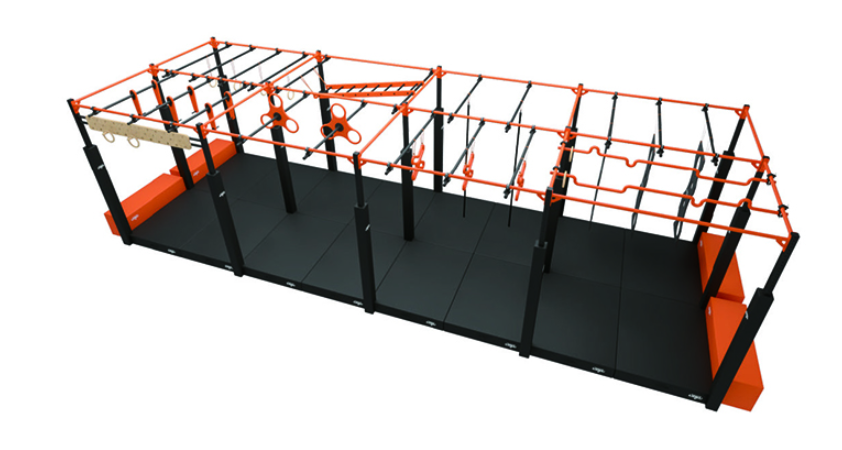
Consider a climbing frame as an example. One of the uses is a ladder climb that is designed for beginners. However, if you change the grips, it can become a horizontal climb that requires upper body endurance. Adding a clock can create a speed challenge for competitive racers. Modular designs are great as they allow you to change the level of challenge of an obstacle without changing the obstacle itself. This allows you to keep the course fresh for revisit participants and also lets you prepare for the type of people that are showing to race. Therefore, for a family event, you would set the course to easy challenges and for a competitive weekend, the challenges would be tighter. This is why you can create multiple obstacles with versatile equipment.
Customization is a key components in this business
Every event is unique. Customization is very important in the designing of a course considering it is in a stadium, a city park, or in a forest.
In some cases, you want your obstacle to go with a certain theme, or you want to use the natural features of the area. In other circumstances, you may want to change the existing layout to better fit the demographics of your participants. For example, if your event is aimed at children, you would want obstacles that are lower to the ground. Bright colors can also help make the obstacles less intimidating. For a corporate team building exercise, you would want to include obstacles that require several participants to work together to complete the task.
Finding a supplier who understands the impact of these details is very important. They can help you with adjusting heights, grip positions, and overall flow to align better with your vision. When you make a custom order, you go the extra mile for your participants. This kind of thought makes your event look more professional and attentive.
The significance of post-sales service.
Not much is said about the moments after you receive your order. This is especially true when you consider the fact that the obstacles you buy are subjected to a lot of wear and tear. For one, the equipment is very much outdoors. The other is that these obstacles will, at some point, be subjected to mud, sweat, and water. They are also misused, and people will swing, drop, and climb on them. And, a matter of time, certain components of the obstacles will have to be replaced or will be broken.
A good after-sales service is very important and is a game changer in a good way. If a grip breaks or if you lose a bolt, it is important to be able to get a replacement easily and quickly. If you are running a business or an event that is happening more than once, this is crucial. When you have unhappy customers and are losing money because of downtime, a supplier who removes the hassle of sending replacement parts is priceless. This is how you can keep your obstacle course equipment to a high level of maintenance each year, preventing it from being outdated, and making sure it is safe and keeps being fun for everyone.
Putting everything together
How do you scale an obstacle challenge for all ages and fitness levels? It all begins with planning. Determine your user personas and design your course flow with them in mind.
Use modular equipment that gives you plenty of options, and most importantly, flexibility. Safety should be your top priority. Be willing to customize certain components to make your event memorable. Most importantly, make sure you have a good maintenance and support system in place.
Seeing pieces come together is so fulfilling. Picture a father and a daughter running together, attacking the same wall, but with different techniques. Picture a group of office workers helping each other over a cargo net, erupting in laughter. Picture elite level competitors giving their all to the same rig in a race against the clock for a new personal record. That is the beauty of a well scaled obstacle challenge. It includes everyone. It asks everyone to play at their level. That is how you build a community.
It's clear there is a mentality that in order to make a successful event we need to include the most challenging obstacles in the world. While that could hold true to certain participants, the bigger challenge is to provide the experience to everyone that they feel they were able to overcome obstacles in a way that was meaningful. When people walk away from a challenge feeling a new sense of appreciation for what they were able to overcome, it's a mark of a successful event. That's the aim.