
 EN
EN

What are the design principles behind professional-grade World Obstacle equipment?
Watching elite athletes at a world obstacle event makes the event look incredibly easy. The obstacles do not look difficult at all, even the most inviting somewhat dangerous. Professional-grade obstacles are easy to underestimate since a lot of research and design effort is put into them, and from the ground to the top of the design everything from which materials are used to the safety of the obstacles, to how athletes will interact with the obstacle, is used to enhance their design.
For most people, the difference between a backyard set and a world championship is a little more than aesthetic. There is more to professional-grade equipment than what first meets the eye.
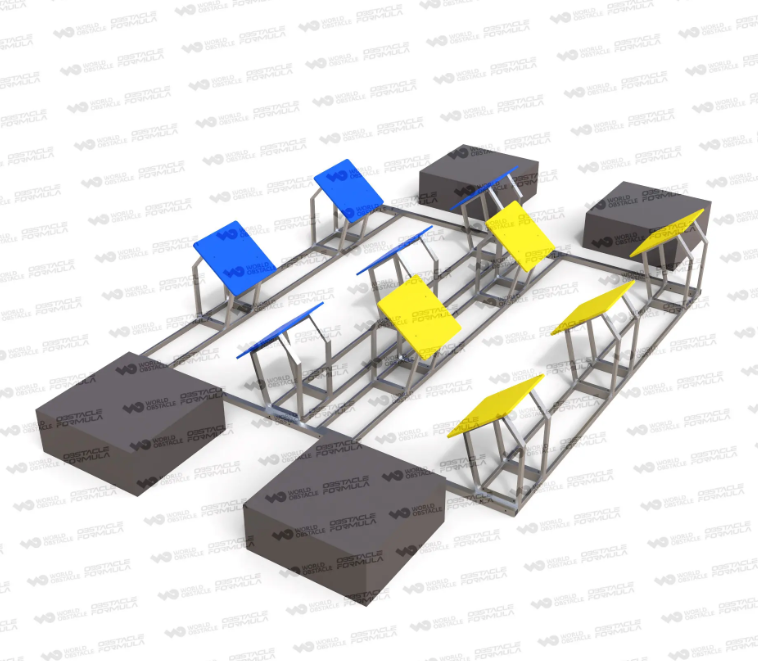
All about the athlete
The most principle of professional-grade designs are all about the athletes. The use design principle has to be about the athletes. Athletes are, by nature, all different. At a world championship, each athlete’s world obstacle challenge will be completed by different people. Custom design is where great design really meets the challenge.
Let’s use grip size as an example. A professional obstacle does not consider every athlete to have the same hand size. Grips are made to fit varying sizes of athletes while still presenting the same challenge to everyone. The same applies to the spacing between holds, climbing angles, and wall heights. All measurements are made with the athlete’s perspective in mind.
Part of this is also confirming that the obstacle tests the required skill. A good obstacle shouldn’t just be made to be hard. It’s created to challenge specific movements, or a mix of several. This way, athletes can understand their goals, and event organizers recognize the purpose of every obstacle.
Engineering safety
Safety is never an afterthought. It’s integrated at every stage of the design process. This is why, for professional events, obstacles undergo extensive engineering evaluations before they are installed for athletes to use.
Engineers assess load-bearing capacity. They consider the impact of the swing of a pole vaulter, the impact of multiple pole vaulters on the same crossbar, and the eventual collapse of the pole vault. The civil engineering structures must be designed to withstand all unforeseen and unintended uses. This involves flexible steel, long-lasting welds, and bolt connections that remain tight despite continual use.
The design of high-level obstacles takes into account all the possible injuries caused by missed attempts by participants. This includes ensuring the safe fall area is crash pad, water, and soft landing surface.
Constructed with durability and consistency in mind
Designing and building professional obstacles requires consistency and reliability. When running a multi-nation competition, you don’t want to be surprised by poor quality obstacles. All obstacles must provide the same experience every time. This is the reason for the design principle of consistency.
It all begins with distribution. Professional obstacles are built around the concept of achievable consistency. The equipment is uniform, and tightly controlled tolerances—with the same manufacturing defect on each piece—result in a grip that is identical to and interchangeable with all others. The design aimed to ensure consistent experience for all participants, regardless of where they are.
In the case of reliability, it also means durability. These obstacles are used time and time again. Often, they are used in extreme weather conditions. They get rained on and muddy, and are transported to different venues to be used again. A well made obstacle acknowledges this and is made to withstand it. The right materials are chosen to withstand the long term affects of use. Coatings are applied to promote the longevity of the materials by protecting against rust and corrosion. And, finally, the moving parts are purposely selected to ensure they have the ability to be used 100’s of times and keep their movements smooth.
Cross-discipline versatility
Professional obstacle course racing designers also have a vision for the obstacles they create. They envision them being used for different activities. A structure created for a world obstacle course racing event would also be suitable for ninja competitions and even endurance racing. That is, in fact, their goal.
In considering how to design an obstacle, the potential for it to be modified is a major consideration. The same frame might be used with a different set of grips to create an easier or harder challenge. A climbing wall might be used in short sprint races as well as in longer endurance races. For event organizers, this versatility is essential for ensuring they have the right equipment for a variety of different event formats.
Obstacles with shared design elements allow competitors to direct their attention to developing the necessary skills instead of having to learn how to use different equipment when they show up to different races. The consistency across events helps them focus on improving their skills. That consistency is an important part of the overall professional design.
Setting up with flexibility
Variability in style and clarity characterizes professional competitions. A world tour may require a large setup with numerous and varied obstacles, while a local qualifying competition may require smaller setups. Thanks to modular design, both instances can be served.
The primary building block of a modular obstacle is a system of components that can be assembled and configured in different ways from single structure up to large systems. Event organizers can purchase a system intended for a large number of obstacles and/or configuration events, and useable for smaller events, and it can be expanded by adding pieces. This flexibility is important for organizers to scope and purchase equipment that can be used in a variety of configurations and locations for years.
Maintenance is modular as well. If a component wears and needs to be replaced, you only have to change that one. You don’t have to replace the whole obstacle. This saves money and increases the length of service for the equipment.
Built for use and upkeep
It may not be the case with lower-quality obstacles, but the equipment is designed to be used and for upkeep to be standard. Planning for the long haul requires that you think of what will happen in five years, as you look ahead.
It can be designed to use readily available components so that it is easier to locate replacement parts. Designed so that the joints can be assembled or disassembled using no more than simple hand tools. Designed so that the most frequently replaced components can be rapidly changed.
Good design will also incorporate a good understanding of maintenance tasks. What maintenance is safe? What is the recommended frequency of bolt inspections? What are the symptoms of wear to the equipment? When these issues are considered at the design phase of the project, the equipment will be safe and usable for a long time.
Integration
The fundamental design principles of the professional World Obstacle equipment is centered around 1 principle. It is good equipment that enables athletes to concentrate on the challenge of the course and not on the concerns of the obstacles integrity. It is designed with a profound understanding of its users, how the equipment will be used, and potential failure modes.
From the outset, safety is designed in. Athletes can rely on equipment to be consistent and safe. Event organizers can use the equipment for a broad range of events. Due to the maintenance focus, equipment is designed to be used for a long time.
A world class event is the culmination of many of the most important principles coming together. It is not about building obstacles that look great. It is about building equipment that functions, protects, and lasts. That is what the term professional grade means.